02/25/09

* Israel: Iranian nuclear test ‘bad news’ Iranian and Russian nuclear officials tested Wednesday the first nuclear power plant built in Iran – a move likely to raise concerns among the US and its Western allies.

* Turkish PM: Israel must recognize Palestine Turkish Prime Minsiter Recep Tayyip Erdogan said Tehran has sought Anakara’s help in finding a solution for its diplomatic crisis with the United States.

* Hamas, Fatah to begin talks in Cairo With stakes that have never been higher, Palestinian factions will open talks in Cairo on Wednesday.

* PA official: Peace process dead Israel’s impending new government indicates that the peace process “has died”.

* Quartet planning to meet in Sharm ahead of Gaza donors’ conference Foreign ministers from the four powers heading a Middle East peace process may meet in the Egyptian town of Sharm el-Sheikh on March 1.

* ‘Bombed Syrian reactor now missile base’ Syria has revealed that it has built a missile facility over the ruins of what the US says was a nuclear reactor destroyed by IAF warplanes.

* Iran sees Palestinian issue as test for Obama’s “change” slogan Iran’s Parliament (Majlis) Speaker, Ali Larijani, said on Wednesday the Palestinian issue is a test for U.S. President Barack Obama’s “change” slogan.

* Gaddafi: Foreign forces, including Israel, behind Darfur conflict Libyan leader Muammar Gaddafi, the current African Union president, on Tuesday said that “foreign forces,” including Israel, were behind the Darfur conflict.

* Hamas Promises to Keep Smuggling in Arms A top Hamas official has declared that his Palestinian terrorist group will continue to smuggle weapons into Gaza, despite international protests.

* Major controversy in Turkish parliament Ahmet Turk, created a major controversy when, on Tuesday, he became only the second person in history to speak Kurdish in the Turkish parliament.

Peace Winner Blair Wins $1 Million, Wants Hamas Part of Solution

By: Tzvi Ben Gedalyahu – Arutz Sheva

The University of Tel Aviv has awarded Quartet Middle East envoy Tony Blair a $1 million prize for his efforts to make peace in the Middle East, weeks after he said that Hamas must be brought into the solution to the Arab-Israel conflict.

The international Dan David Foundation prize went to the former British prime minister “for his exceptional leadership and steadfast determination in helping to engineer agreements and forge lasting solutions to areas in conflict.”

A spokesman for Blair said that most of the money will be donated to the Tony Blair Faith Foundation for “religious understanding.”

Most of Britain’s newspapers roundly mocked the award, citing Blair as a warmonger for backing the American-led war in Iraq.

As prime minister and Quartet envoy, Blair has been at the forefront in pressuring Israel to make concessions to the Palestinian Authority, and accepts most of the PA’s conditions for a new Arab country on the land of Judea, Samaria and Gaza, including the Jewish Quarter in Jerusalem.

Early last month, Blair stated, “I do think it is important that we find a way of bringing Hamas into this process, but it can only be done if Hamas [is] prepared to do it on the right terms.”

He told the Times of London that “pushing Gaza aside was never going to work and will never work.” Although he maintained that Hamas must recognize Israel and renounce violence, he added that his “basic predisposition is that in a situation like this you talk to everybody.”

Blair, who will be honored by the University of Tel Aviv May 17, was roundly criticized in British newspapers. The Sunday Sun wrote that the father of a soldier whose son was killed in Iraq called on Blair to reject the $1 million prize.

“This is a man who has led us into two wars which have resulted in the deaths of hundreds of thousands of people in Iraq and Afghanistan and for this he is to be given a million dollars. It really is beyond belief,” John Miller told the newspaper.

London Telegraph columnist Andrew Pierce wrote, “A clue to why he won may be that the Dan David Foundation is based at a university in Tel Aviv. In case you had forgotten, Blair is the Middle East peace envoy. And very good he is at it, too.

“So good that he has yet to set foot in Gaza since he took up the post two years ago. Instead, he is holed up in a suite on several floors of a smart Jerusalem hotel, and when he leaves it is in a bulletproof, bomb-reinforced security convoy.”

Please note: These stories are located outside of Prophecy Today’s website. Prophecy Today is not responsible for their content and does not necessarily agree with the views expressed therein. These articles are provided for your information.

Brown: World needs ‘global New Deal’

By: CNN Bureau Chief Frederik Pleitgen – Cable News Network

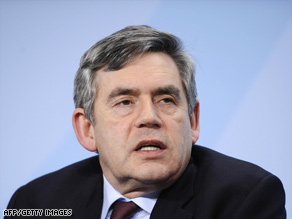
BERLIN, Germany (CNN) — The world needs a “global New Deal” to haul it out of the economic crisis it faces, Prime Minister Gordon Brown of the United Kingdom said Sunday.

Gordon Brown addresses a press conference following a G20 preparatory meeting in Berlin, Sunday.

Gordon Brown addresses a press conference following a G20 preparatory meeting in Berlin, Sunday.

“We need a global New Deal — a grand bargain between the countries and continents of this world — so that the world economy can not only recover but… so the banking system can be based on… best principles,” he said, referring to the 1930s American plan to fight the Great Depression.

Brown was speaking as the leaders of Europe’s biggest economies met to try to forge a common position on the global financial crisis ahead of a major summit in London in April.

French President Nicolas Sarkozy said the world’s response to the global financial meltdown had to be profound and long-lasting, not just tinkering around the edges.

“Europe wants to see an overhaul of the system. We all agree on that. We’re not talking about superficial measures now or transitional measures — we’re talking about structural measure, which need to be taken,” he said.

German Chancellor Angela Merkel, the host of the meeting, urged nations of the world to work together to fight the problem.

“Confidence can only be restored if people in our countries feel that we are pulling in the same direction and have understood that we really must learn lessons from this crisis,” she said.

And she proposed that a new institution grow out of the crisis, “which will take on more responsibility for global [financial] mechanisms.”

The Europeans say they have agreed international financial markets must be regulated more thoroughly. That also means stricter rules for hedge funds and credit-rating agencies.

European and world leaders have been holding frequent summits as they struggle to cope with a financial crisis that has affected banks, homeowners, businesses and employees around the world.

London will host a meeting of the Group of 20 nations in April. The G-20 includes the G-7 leading industrialized nations — Canada, France, Germany, Italy, Japan, the United Kingdom and the United States — as well as the world’s largest developing economies: Argentina, Australia, Brazil, China, India, Indonesia, Mexico, Russia, Saudi Arabia, South Africa, South Korea and Turkey, plus the European Union.

The managing director of the International Monetary Fund and the president of the World Bank, plus the chairs of the International Monetary and Financial Committee and Development Committee of the IMF and World Bank, also participate in G-20 meetings.

Please note: These stories are located outside of Prophecy Today’s website. Prophecy Today is not responsible for their content and does not necessarily agree with the views expressed therein. These articles are provided for your information.

EU Commission hails enlargement

By: BBC News

The European Commission says the 27-nation EU must not let the current economic crisis jeopardize the gains of eastward enlargement.

European flags outside the EU (file)

The European Union is now the world’s biggest integrated economic area

A commission report says the accession of 12 states since 2004 – mostly ex-Soviet bloc countries – boosted living standards and business opportunities.

It said enlargement served as an anchor for stability and driver of democracy.

But there are concerns that EU states may be tempted to prop up weak domestic firms at their neighbors’ expense.

The BBC’s Chris Mason in Brussels says the impact of the economic crisis threatens to undermine the single market, a founding tenet of European integration.

‘Peace and prosperity’

The European Union took in 10 mostly ex-communist countries in Central and Eastern Europe in 2004 and two more, Romania and Bulgaria, in 2007.

It is now the world’s biggest integrated economic area, with half a billion people producing 30% of global economic output and 17% of world trade.

In the report on published on Friday, the commission said enlargement had brought about huge economic and political benefits for both sides.

Income per capita in new member states rose from 40% of the old member states’ average in 1999 to 52% in 2008. Economic growth averaged 5.5% per year in 2004-2008, compared to 3.5% in 1999-2003.

The old member states averaged annual growth of around 2.2% in the last four years.

Enlargement also increased trade opportunities. In 2007, almost 80% of exports of the new member states went to the rest of the EU. Old member states also saw their sales to the new members increase to around 7.5% of their total exports in 2007, from 4.75% a decade ago.

Unemployment in new member states declined to levels similar to those across the rest of the EU – around 7% in 2007.

“Enlargement has served as an anchor of stability, and driver of democracy and the rule of law in Europe,” Enlargement Commissioner Olli Rehn said.

“Economically it has benefited both new and old member states, as well as the EU as a whole. It has extended the area of peace and prosperity to almost 500 million people and increased our weight in the world,” he added.

Protectionism fears

But some of the poorer member states fear protectionism is on the rise in richer countries, our correspondent says.

The old member states can afford to spend billions of dollars to shield their banks and industries from the crisis, he adds.

“We should not let the crisis overshadow this uncontested success. United, we can shape the solution to global issues such as climate change or a new international financial governance,” Economic Affairs Commissioner Joaquin Almunia said. “Divided we will achieve nothing.”

An emergency summit will take place in Brussels on 1 March partly to discuss protectionism.

Please note: These stories are located outside of Prophecy Today’s website. Prophecy Today is not responsible for their content and does not necessarily agree with the views expressed therein. These articles are provided for your information.

Poll: Israelis split on taking Evangelical charity

By: Etgar Lefkovits – The Jerusalem Post

More than 40 percent of Israeli Jews, including nearly 80% of the Orthodox, believe Jewish groups should not accept charity from evangelical Christian organizations, a survey released Sunday found.

The study, which highlighted the sharp differences of opinion between secular and religious Jews on Christianity, was published amid growing support for Israel from evangelical Christians, who donate tens of millions of dollars each year.

Fifty-five percent of respondents said Israel should accept charity from Christians missionaries, while 41% were against accepting such funds, according to the survey carried out for the Jerusalem Institute for Israel Studies and the Jerusalem Center for Jewish-Christian Relations. Seventy-nine percent of Orthodox Israelis said Jewish groups should not accept such charity, compared to 70% of secular Israelis who said they should.

The survey results did not separate responses from haredim – who are more opposed to accepting such money – and modern Orthodox Jews.

“The vast majority of the Israeli public is not mistaken: Twenty-five years of the existence of the International Fellowship of Christians and Jews are the unequivocal proof of the unwavering sympathy of the evangelical Christians toward the people of Israel and to their long support for the State of Israel,” said Limor Bar On, a spokeswoman for the Chicago-based Christian charity group.

The organization, which is headed by Rabbi Yechiel Eckstein, said it received $87 million from evangelical Christians last year for a variety of immigration and absorption programs, as well as social welfare and defense needs.

“This essential support would not be possible without the generous contribution of hundreds of thousands of evangelical Christians in the US and around the world,” she said.

“The results of the survey show that we have had a lot of success and a lot more work to do to convince Israelis that we are true friends in a world which is becoming more hostile and more anti-Semitic every day,” said Rev. Malcolm Hedding, the executive director of the International Christian Embassy in Jerusalem, a prominent Jerusalem-based evangelical group. “Israelis should recognize who their true friends are by virtue of their track record, and we stand on our proud track record of 30 years.”

Seventy-four percent of Israeli Jews do not regard Christians as “missionaries,” while 76% are not bothered by encountering a Christian wearing a cross, the survey showed.

At the same time, only 50% of Israeli Jews agreed that Jerusalem was central to the Christian faith, and 75% believe the state should not allow Christian groups to buy land to build new churches in the capital, the survey found.

Forty-one percent of Israeli Jews believe that Christianity is the closest religion to Judaism, compared to 32% who cited Islam, according to the survey.

Eighty percent of secular Jews believe they are allowed to enter churches, and 92% of them visited churches when abroad, while 83% of religious Jews said that visiting churches is forbidden by Jewish law.

More than three out of every four religious Jews believe Christianity is “idol worship,” while 66% of secular Jews do not, the survey found. Fifty-six percent of secular Jews believe that Christian soldiers in the IDF should be allowed to use the New Testament for swearing allegiance to the state, but 62% of religious Jews think only the Torah should be used.

The data for the Rafi Smith Institute survey was collected last March among 500 Jews from various streams. The study did not cite a margin of error.

Please note: These stories are located outside of Prophecy Today’s website. Prophecy Today is not responsible for their content and does not necessarily agree with the views expressed therein. These articles are provided for your information.

02/24/09

* ‘I won’t wait forever for unity gov’t’ Likud chairman Binyamin Netanyahu publicly pledged on Monday afternoon to do whatever possible to build a national unity government with Kadima or Labor.

* Saudis replacing Egypt as regional leader A recent U.S. National Intelligence Council report suggests Egypt has lost its superior status among Arab states.

* Peres: Europe must stop Hamas support European leaders must continue to publicly condemn Hamas and its actions rather than express support for dialogue.

* Hamas: We reserve right to bring arms into Gaza Gaza-based Hamas strongman Mahmoud Zahar declared Tuesday that his Islamist militant group reserves the right to bring arms into Gaza.

* Iraq’s National Museum reopened Iraq’s National Museum has reopened nearly six years after it was looted and vandalised in the aftermath of the 2003 US-led invasion.

* Ross named special US envoy on Iran Dennis Ross joined the Obama administration in a coordinating role on policy regarding Iran and its neighbors on Tuesday.

* Jewish Home: Committed to Judea & Samaria As part of its role in any future government, the Jewish Home party says it is committed to promoting Jewish communities in Judea and Samaria.

* U.S. to open permanent Jerusalem office for envoy The United States is planning to open a permanent office in Jerusalem for its special envoy to the Middle East.

* Big groups to retain power in EU parliament The balance of power in the European Parliament would stay broadly the same if elections were held today.

* Museum aims to piece together Iraq’s plundered past Iraq’s National Museum will again be home to the country’s treasures.

Is Pakistan spinning out of Control?

By: – Col. Bob Maginnis

Last week, a deal between Pakistan’s government and radical Islamists to exchange peace in Pakistan’s ungoverned northwest for the imposition of Sharia (Islamic) law fortunately failed. But the fact that such a deal was even considered indicates that Pakistan is crumbling and the region is at risk of spinning out of control. Such a state of affairs diminishes America’s chances of success in Afghanistan and raises the specter of Pakistan’s nuclear arsenal falling into the hands of Islamic extremists.

That’s why President Obama’s soon to be announced strategy for the region is critical. Pakistan is the center of gravity of the global war on terror and radical Islam is the enemy’s ideology. Obama’s plan must help stabilize Pakistan and deny our Islamist enemies sanctuary in that country.

On Feb. 16, the North-West Frontier Province government, after consultation with Pakistan’s President Asif Ali Zardari, announced that it would accept a system of Islamic law in the Swat Valley, a strategic corridor first infiltrated in 2007 by Taliban militants and the scene of a failed army counteroffensive. The parties agreed to a truce, and the government suspended its efforts to crush the insurgents.

This pact is similar to previous government accords with militants in the semi-autonomous tribal areas in North and South Waziristan. Those regions have become mini-states for Taliban and al Qaeda extremists and are used as insurgent launching pads for operations into Afghanistan and Pakistan.

Shortly after the deal was announced, media reports indicated that unnamed American officials in Islamabad privately backed the deal as an attempt to drive a wedge between Swat’s Taliban, which is focused on its demand for Sharia, and the al-Qaeda-linked Taliban that controls the tribal areas along the Afghan border.

A Pakistani official insisted the Obama administration “… showed understanding of our strategy.” That “understanding” must have changed because President Zardari, reportedly under pressure from Washington, has backed away from the controversial agreement without public explanation. Over the weekend the most powerful Taliban leader in the Swat, Maulana Fazlullah, said he had only agreed to a 10-day-truce, not a “permanent cease-fire.”

At this time, the deal appears to be off, but it’s highly likely a similar agreement will resurface and other regions will seek comparable arrangements.

The deal was seen as a desperate effort to stop Taliban abuses against the population, a major military embarrassment. The proposed pact would disarm about 3,000 Taliban fighters who have kept government troops pinned down while terrorizing the Swat region’s population with Islamic justice: it torched nearly 200 schools, banned female education, forced women to stay indoors and executed dozens of government employees, especially policemen.

Pakistani officials insist the deal is urgently needed for peace and as a model for other areas ravaged by Islamic radicals. They argue the switch to Sharia law is consistent with Pakistan’s secular constitution and presented no threat to the integrity of the nation.

Prominent Pakistanis for and against the deal provided plenty of grist for the debate. Those favoring the agreement argue:

  • People in Swat are very conservative and have been demanding the implementation of Sharia law because it would expedite justice and reduce legal costs.
  • Elements of the religious judicial system have been in the Swat region since 1994 without problems.
  • Pakistan’s army was unable to defeat the insurgents and the civilians were suffering. The deal will provide peace.

Opponents argue the deal:

  • Shows the government has no coherent plan for combating militancy.
  • Demonstrates if you are powerful enough to challenge the writ of the state, it will cave in.
  • Provides the Taliban with a launching pad from which to spread anarchy deeper into Pakistan.

America’s chances for success in Afghanistan will diminish if Pakistan further surrenders its sovereignty to regional Sharia-based systems because — predictably — those regions will support the Taliban, their terrorist allies and disrupt our operations against them.

Pakistani ground transportation moves U.S. supplies from the port at Karachi through two crossing points on the Afghan border. Already, militant attacks on that lifeline have increased to the point that Washington is scurrying to find alternative resupply routes. If these transit regions further become Taliban sanctuaries, there is a significant risk that the supply routes could be permanently closed and the area will become base camps for Taliban fighters to launch attacks on allied troops.

So what should President Obama do? His war strategy must address how to stabilize Pakistan and deny our enemies sanctuary in that country.

Pakistan is stressed by extremists on its western border, but its primary strategic focus is on India and Kashmir, a half century old rivalry. Any American strategy that expects Islamabad to concentrate on West Pakistan must first restrain New Dehli and resolve the Kashmir crisis.

The Obama strategy should also recognize that America’s enemy in Afghanistan is primarily the Taliban. Yes, al Qaeda still exists, but its ranks are dwindling rapidly, and it presents more of a psychological than operational threat.

The Taliban has a long history of resilience and enjoys a home turf advantage both in Pakistan and Afghanistan. Working with Islamabad, the Taliban can be dealt with from a couple perspectives.

Many Taliban are poor, uneducated Pashtun mountain men who primarily seek the means to care for their families. A jobs program and schools that teach academics rather than radical Islam might prevent some men from joining the insurgency.

Others may be convinced to join a coalition government where they share power with secular authorities and yes, a government that is influenced by their Islamic beliefs, but not based on radical Sharia code. Of course, any coalition government would have to be relatively corruption free, which will be a challenge in a part of the world where warlords and tribal loyalty prevail.

Even so there will continue to be diehards driven by radical Islamic hatred, and they will only understand the muzzle of a gun.

That means the military option has a legitimate place in the President’s strategy. Obama must seek a close working relationship with Pakistan to protect our supply lines and destroy Taliban base camps. Islamabad is unlikely to support significant numbers of U.S. troops on Pakistani soil, but a few Americans working as “advisors” along side Pakistani soldiers might work.

A parallel and potentially better military option would be to provide Pakistan with the means to deploy more of its own troops into the Islamist infested frontier. This will require further U.S. military equipment and training aid, especially for fighting counterinsurgencies.

The failed deal between Islamabad and the Taliban is a bad omen for U.S. interests in the region. It suggests the Pakistanis may lack a strategy to deal with extremists, preferring accommodation rather than confrontation. That hurts American efforts in Afghanistan, the greater war on terror and could push nuclear-armed Pakistan into the arms of Islamic extremists.

Please note: These stories are located outside of Prophecy Today’s website. Prophecy Today is not responsible for their content and does not necessarily agree with the views expressed therein. These articles are provided for your information.

02/23/09

* Al Qaeda No. 2 warns against Gaza truce Al Qaeda’s No. 2 warned Palestinians in Gaza against accepting a truce with Israel in an audio message posted on extremist Web sites.

* EU worried over Bibi’s peace plans EU officials raised concerns Monday over the commitment of Prime Minister-designate Binyamin Netanyahu to pursue genuine peace talks with the Palestinians.

* Global jihad could be behind rockets Al-Qaida affiliated global jihadi groups could be playing an important role in the trickle of rocket fire and border attacks being directed against Israel.

* New U.S. Intel Chief: Support of Israel Not a U.S. Interest A flurry of reports over the weekend said that the former U.S. ambassador to Saudi Arabia, considered a sharp critic of Israel, is to be named to a top intelligence post in the administration of U.S. President Barack Obama.

* Iran secretly accelerated A-bomb drive Iran is speeding ahead toward the production of a nuclear weapon, and is operating a shadow nuclear program in tandem with its public program to achieve that goal.

* Israelis split on taking Evangelical charity More than 40 percent of Israeli Jews, including nearly 80% of the Orthodox, believe Jewish groups should not accept charity from evangelical Christian organizations.

* EU Commission hails enlargement The European Commission says the 27-nation EU must not let the current economic crisis jeopardise the gains of eastward enlargement.

* EU nations call for better financial regulation Leaders from the EU’s largest economies have called for stricter regulation of the financial sector to prevent a repetition of the current crisis.

* Brown: World needs “Global New Deal” The world needs a “global New Deal” to haul it out of the economic crisis it faces said UK PM Gordon Brown.

* Peace Winner Blair Wins $1 Million, Wants Hamas Part of Solution The University of Tel Aviv has awarded Quartet Middle East envoy Tony Blair a $1 million prize for his efforts to make peace in the Middle East.

What is behind Turkey’s antagonism toward Israel?

By: Anat Lapidot-Firilla – Haaretz

There are many different theories about Turkey’s increasingly harsh criticism of Israel and its treatment of the Palestinians. Some have suggested that the hostility is grounded in the internal struggle between Turkey’s secular military and the country’s Islamist ruling party. By this logic, Prime Minister Recep Tayyip Erdogan’s attacks on Israel are meant to embarrass the army, which has extensive links with Israel’s military establishment. Others view Turkey’s vocal support for Hamas as indicative of an explicit decision on the part of the ruling Justice and Development Party (AKP) to pull the country out of its alliance with the West – while drawing closer to Iran.

An explanation that has gained acceptance among the shrinking Turkish opposition is that AKP’s foreign policy in general, and toward Israel and Hamas in particular, is linked to Erdogan’s religious agenda. Others view the escalating anti-Israel rhetoric as a symptom of the populist political atmosphere, as Turkey gears up for local-government elections, in late March. And still others view the heightened tension through the lens of regional and international hegemonic struggles. But, even proponents of that approach are having trouble explaining the intensity and tenacity of Turkish insistence on being the one and only regional mediator, and the rage directed by Erdogan at Israel’s premiers (not only Ehud Olmert, but also Ariel Sharon before him) for not giving him proper respect and allowing him to exercise what he suggests is his rightful role as a regional mediator.

Indeed, Erdogan’s statements about Israel have to be seen in the context of Turkey’s changing self-perception vis-a-vis its neighbors and the rest of the Muslim world. Turks increasingly propound a vision of their nation as the moral leader of both. They see themselves assuming a burden inherited from their Ottoman forbears, whose empire stretched from North Africa to Europe and Central Asia, a mission that includes fostering regional peace and stability, as well as economic prosperity.

The “Turkish man’s burden” requires both taking a more critical stance toward Israel and being seen as protector of the Palestinians. Mediating between Israel and Syria is the other side of the same coin of Turkey’s changing self-perception.

In this sense, the shrill complaints about Israel’s Gaza offensive do not diverge from the accepted discourse in Turkey in recent years. But it has certainly become sharper and more militant. Attacks on Jewish-owned properties, an “enlisted” press, and the use of state educational and religious institutions to instigate an anti-Israel campaign are only some examples. Israel is portrayed as barbaric, uncivilized, as well as ephemeral, and the Arab regimes that have failed to rush to the defense of the Palestinians are described as dictatorial and lacking in moral legitimacy.

The idea of Turkey as leader of the Sunni Muslim world is not new. It should be recalled that even toward the end of the Ottoman Empire, as the “civilizing project” of founding father Mustafa Kemal Ataturk, which embraced secularism and Westernization, was starting up, a feeling of responsibility toward the Arab and Kurdish periphery was developing. Agents of “the project” were sent out to the provinces to disseminate its ideas, and the descendants of tribal elites from all over the empire were assembled for re-education in Istanbul, in the hope that when they returned home they would spread the values of Turkish civilization. At the time, this sense of burden also competed with parallel French, and even American, cultural enterprises in the region. However, with Ataturk’s rise to power at the end of World War I, and during the entire Kemalist period, the civilizing efforts were directed inward, with a policy of disengagement from the Arab and Muslim Middle East prevailing through the 20th century.

Erdogan himself has explained his behavior in Davos, where he stormed off stage in reaction to criticism by Israeli President Shimon Peres, as an attempt to defend the honor of the Turkish nation. He is not the first Turkish leader to feel he is entrusted with such a responsibility. Ataturk, and Adnan Menderes – the prime minister overthrown and hung following a military coup in 1960 – are both examples. However, their declarations used to be focused on Turkey domestically.

The dissolution of the Soviet Union reawakened some imperialist notions in Turkey. It began with a sense that it was Turkey’s responsibility to introduce democracy to the Turkic populations in the former Soviet republics. These days, the AKP is conducting an information campaign aimed at repositioning Turkey in Central Asia, the Balkans and the Arab Middle East. In its aspiration to hegemony, Turkey is competing with both Iran and Egypt – and, in its imagination, maybe even Israel.

The Kemalist elite is uncomfortable with this attitude. Its members are embarrassed by Erdogan’s public outbursts, even if criticism of Israel is acceptable to most. The premier’s “non-normative” outbursts have led some establishment commentators to go so far as to publicly question his psychological stability.

The new Turkish “burden” highlights the fact that Turkey is part of the Muslim Middle East. Just as the Kemalists were gearing up for accession to the European Union, Erdogan came along and emphasized the very elements they had tried to suppress for the past century. Just this week, journalists and academics associated with AKP launched a campaign asserting that Europe has no future without Turkey, a claim that seems detached from 21st-century realities. Reality, rather, demands the furthering of reforms and compliance with EU requirements.

Although it is unlikely to happen, it may now be time for Erdogan and his advisers to reassess their foreign policy toward both Israel and Europe, and to tone down their rhetoric. Erdogan’s insistence that he is no anti-Semite is probably sincere. But arguing that the world’s media are controlled by Jews may not be the best way for him to make his case.

Anat Lapidot-Firilla is a senior research fellow at the Van Leer Jerusalem Institute and teaches at the Hebrew University.

Please note: These stories are located outside of Prophecy Today’s website. Prophecy Today is not responsible for their content and does not necessarily agree with the views expressed therein. These articles are provided for your information.

Analysis: Turkey’s shift toward Iran, Syria is no short-term blip

By: Jonathan Spyer – The Jerusalem Post

Last weekend, a conference held under the title “Gaza the victory” took place at hotel near Istanbul’s Ataturk airport. The conference brought 200 Sunni clerics and activists together with senior, Damascus-based Hamas officials.

Turkish women chant Islamic...

Turkish women chant Islamic slogans as they wave Palestinian flags at Abdi Ipekci arena in Istanbul.
Photo: AP

Closed meetings held after the main conference sessions focused on the creation of a “third jihadist front” against Israel – the first two being Iraq and Afghanistan, in the view of the conference delegates. The gathering was addressed by Muhammad Nazzal, a top Hamas official from Damascus.

In an echo of the attempts by Islamists across the Middle East to pressure Egypt during the recent Gaza operation, Nazzal called on regional governments to “open the borders and let the fighters through.”

The gathering in Istanbul is significant for two reasons. First, it showcases the continued efforts by Islamist movements to present the Gaza events as a watershed dividing the path of “resistance,” which they favor, from the path of “collaboration” that they accuse leading Arab states of following.

Second, and perhaps more important, the location of the conference is a further indication of the move of the Islamist AKP government in Turkey toward a more and more open alignment with anti-Western and anti-Israeli forces in the region.

The conference organizers themselves were aware of the significance of the event’s location. One of them told a BBC journalist attending the event, “During the past 100 years relations [between Arabs and Turks] have been strained, but Palestine has brought us together.”

Speakers at the conference made constant reference to Turkish Prime Minister Recep Tayyip Erdogan’s decision to storm off the stage in protest during a recent debate in Davos, Switzerland, on the Gaza operation.

The current Turkish government’s willingness to engage with and host regional and Palestinian Islamist forces is not new. Hamas leader Khaled Mashaal made a controversial trip to Ankara less than a month after Hamas’s victory in Palestinian Legislative Council elections in January 2006. Interestingly, Mashaal was asked to come directly by the AKP government, after the more secular-minded Turkish Foreign Ministry refused to extend an invitation to him.

At the time, some analysts sought to present the invitation to Mashaal as a one-off gesture without deeper significance for the Israeli-Turkish relationship. Subsequent events have disproved this interpretation.

Turkey’s response to the Gaza offensive has highlighted a deep rift in relations. Erdogan in the course of the operation questioned Israel’s UN membership. The atmosphere in Turkey during Operation Cast Lead became deeply charged against Israelis and Jews – with a number of ugly incidents recorded across the country. Erdogan attended the emergency summit in Doha on January 16 that was convened by Syria and Qatar to offer support to Hamas.

Turkey’s courting of Hamas and hosting of Islamist gatherings form part of a more general regional policy pursued by the AKP government in Ankara. The AKP seeks to build Turkey’s regional “strategic depth” – in its preferred phrase – by building up relations with Syria and Iran. This is presented as a desire to counter-balance, rather than replace, Ankara’s already deep links with the West.

However, in the current situation of sharp polarization and cold war in the region, it is becoming increasingly unfeasible for countries to maintain close relations with both the US-led and the Iranian-led camps. The prospect of Turkey moving toward the Iranian-led alliance can no longer be dismissed as fanciful.

Turkish analysts have noted the rise of a “Muslim nationalist” orientation in the country, of which the political dominance of the AKP over the last half decade forms the political expression.

From this perspective, a regional policy which stresses alliances with other Muslim governments and movements across the region is a natural choice. Growing warmth in Turkey’s relations with Iran and Syria, and the sympathy shown their key client organization Hamas last weekend in Istanbul are all elements of this emerging policy.

Of course, it is much too soon to write off the relationship between Turkey and Israel. There are powerful forces within the country which oppose the AKP’s “strategic depth” orientation. Nevertheless, Turkey’s position on recent events has brought great cheer to the Iranian-led camp, and is leading to corresponding new efforts at courtship from Teheran.

Senior Iranian officials praised Turkey’s stance during the Gaza crisis, and called for a strategic alliance between the two countries. Yahya Safavi, former commander of the Revolutionary Guards and now security adviser to Supreme Leader Ali Khamenei, said earlier this month that “Erdogan’s… courageous words at the Davos summit against the war crimes of the Zionist regime… are evidence of the Islamic awakening among the Turkish people – a result of the influence of Iran’s Islamic Revolution.”

Majlis speaker and former nuclear negotiator Ali Larijani visited Turkey during the Gaza crisis, holding closed talks with Erdogan. Following the meetings, both men called to enhance the already extensive economic links between Iran and Turkey.

Where is Turkey heading?

What can be said with certainty is that Ankara’s long-maintained policy of equidistance between Israelis and Palestinians has been dispensed with by the current leadership. The AKP government is aligning itself not only with the Palestinians, but with Hamas. In the longer term, this may portend a slow shift toward greater alignment with the Iranian-led regional alliance. Such a shift, if it occurs, will be of primary significance to the strategic balance in the region.

Please note: These stories are located outside of Prophecy Today’s website. Prophecy Today is not responsible for their content and does not necessarily agree with the views expressed therein. These articles are provided for your information.